
The 4Cs of Diamonds: A Complete Guide to Choosing the Right Diamond
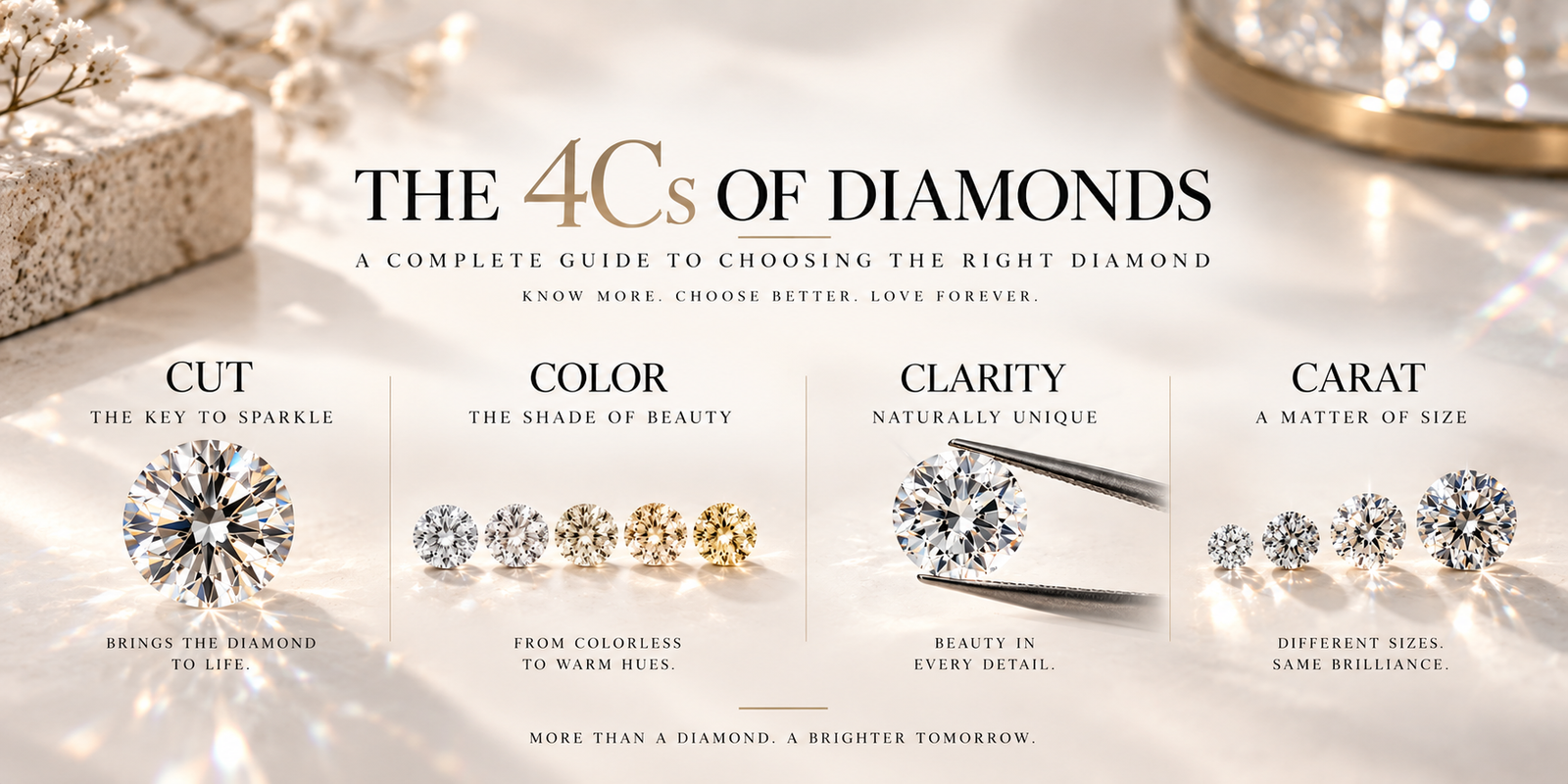
The 4Cs of Diamonds: A Complete Guide to Choosing the Right DiamondBuying a diamond can feel overwhelming at first. You may see terms like cut, color, clarity and carat everywhere, but what do they actually mean? And more importantly, which ones should you care about most?
The answer comes down to the 4Cs of diamonds: Cut, Color, Clarity and Carat Weight.
The 4Cs provide a standardized way to describe and compare diamonds. But choosing a beautiful diamond isn't simply about finding the highest possible grade in every category. A diamond with excellent balance between the 4Cs can often look more beautiful and offer better value than one chosen simply for having the highest grades.
Whether you're shopping for an engagement ring, wedding jewelry, a pair of diamond earrings or a special piece for yourself, understanding the 4Cs will help you make a more confident decision.
Let's take a closer look at each one.
What Are the 4Cs of Diamonds?
The 4Cs stand for:
Cut
Color
Clarity
Carat Weight
These four characteristics are used to describe important aspects of a diamond and help buyers compare stones.
It's important to understand that the 4Cs don't work independently.
A diamond's beauty comes from the combination of its characteristics.
For example, a larger diamond with excellent carat weight may not look particularly impressive if it has poor proportions and cutting. Similarly, a diamond with very high clarity may not look noticeably better to the naked eye than one with slightly lower clarity.
This is why choosing a diamond is about balance, not simply maximizing every grade.
1. Cut: The Key to a Diamond's Sparkle
When people talk about a diamond's sparkle, they are largely talking about the way the diamond interacts with light.
That makes cut one of the most important characteristics to consider.
Diamond cut refers to how well a diamond has been proportioned, faceted, polished and finished to interact with light.
A well-cut diamond can return light beautifully through the top of the stone, creating brightness, fire and scintillation.
A poorly cut diamond may appear darker, duller or less lively even if it has an impressive color, clarity or carat grade.
Cut is not the same as shape
This is an important distinction.
Shape describes the outline of a diamond, such as:
- Round
- Oval
- Emerald
- Cushion
- Pear
- Marquise
- Princess
- Radiant
Cut describes how the diamond's facets and proportions have been designed and finished.
So when someone says they want a Round diamond, they are talking about its shape.
When they say they want an Excellent Cut diamond, they are talking about how well that diamond has been cut.
Why Does Cut Matter So Much?
Light enters a diamond through its surface and interacts with its facets.
When the proportions and angles are well balanced, much of that light is reflected back toward the viewer.
This creates the bright appearance associated with a beautiful diamond.
When the proportions are less effective, light can escape through areas of the diamond rather than returning toward the viewer.
The result can be a diamond that looks less bright.
This is why two diamonds with the same carat weight can look dramatically different.
One may appear lively and brilliant.
The other may look noticeably darker.
If sparkle is your priority, pay close attention to cut.
For round brilliant diamonds, cut grading is particularly well established. Other diamond shapes may be evaluated differently depending on the laboratory and grading system.
2. Color: Understanding Diamond Color Grades
Diamond color is another important part of the 4Cs.
For traditional color grading of white diamonds, the scale generally runs from D to Z.
D
D represents the highest colorless grade.
Diamonds in the top color grades have very little detectable body color.
E and F
These are also considered colorless grades and can offer an exceptionally bright, white appearance.
G to J
These grades are generally considered near-colorless.
They can still appear beautifully white, especially when viewed without magnification and when paired with an appropriate setting.
K to Z
As you move further down the scale, increasingly noticeable warm or yellow tones can become visible.
Does Higher Color Always Mean a Better Diamond?
Not necessarily.
This is one of the biggest misconceptions about diamond buying.
A D-color diamond is technically higher on the color scale than a G-color diamond.
But that doesn't automatically mean you will visually prefer the D-color diamond.
Once a diamond reaches a certain level of colorlessness, the difference between adjacent grades can be subtle to the unaided eye.
The setting can also affect how a diamond's color appears.
For example, a slightly warmer diamond can look beautiful in yellow gold, where its warmth can complement the metal.
This means you don't always need to pay for the highest possible color grade to get a diamond that looks beautiful.
3. Clarity: Understanding Inclusions and Blemishes
Clarity refers to the presence of characteristics inside and on the surface of a diamond.
Internal characteristics are generally called inclusions.
External characteristics are called blemishes.
Natural diamonds form under complex geological conditions, so many contain small internal characteristics that developed during their formation.
Laboratory-grown diamonds can also contain characteristics related to their growth process.
These characteristics are examined under magnification when a diamond is professionally graded.
The Diamond Clarity Scale
The commonly used clarity scale includes:
FL: Flawless
No inclusions or blemishes are visible under the grading conditions used by the laboratory.
IF: Internally Flawless
No inclusions are visible under the grading conditions, although minor surface blemishes may be present.
VVS1 and VVS2
Very, Very Slightly Included.
The characteristics are extremely difficult to see under magnification.
VS1 and VS2
Very Slightly Included.
The characteristics are more noticeable under magnification but can often be difficult to see.
SI1 and SI2
Slightly Included.
Characteristics are easier to see under magnification and may or may not be visible to the naked eye depending on their size, position and type.
I1, I2 and I3
Included.
Characteristics are more obvious and can potentially affect transparency, brilliance or durability depending on the stone.
Does a Diamond Need to Be Flawless?
No.
For most jewelry buyers, a diamond does not need to be flawless to look beautiful.
In fact, many diamonds with lower clarity grades can appear completely clean to the naked eye.
This is sometimes referred to as eye-clean.
The important thing is not simply the clarity grade written on a report. What matters is how the inclusions actually affect the appearance of the individual diamond.
Two diamonds with the same clarity grade can look different because their inclusions can vary in:
- Size
- Location
- Number
- Type
- Contrast
- Visibility
This is why looking at the actual diamond is so valuable when possible.
Why Paying for the Highest Clarity May Not Always Make Sense
Imagine you have two diamonds that look equally clean when viewed normally.
One has a higher clarity grade and costs significantly more.
The other has a slightly lower clarity grade but looks just as clean to your eyes.
If appearance is your priority, the second diamond may offer better value.
This is an important principle when buying diamonds:
Don't pay for a difference you cannot see unless that difference matters to you personally.
Of course, clarity can become more important depending on the diamond's size, shape and inclusion characteristics.
Large diamonds can make inclusions easier to see, and certain shapes can make characteristics more noticeable.
4. Carat Weight: It's About Weight, Not Just Size
Carat is probably the most familiar diamond measurement.
But there is an important misconception:
Carat does not mean size.
Carat measures the weight of a diamond.
One carat equals 200 milligrams.
So a 1.00-carat diamond weighs 0.20 grams.
However, two diamonds with the same carat weight can have different dimensions.
That's because their proportions and cutting can differ.
Carat vs. Visual Size
Consider two diamonds that both weigh 1.00 carat.
One may have excellent proportions and a well-balanced cut.
Another may carry more of its weight in depth.
Both weigh the same.
But when viewed from the top, they may not appear exactly the same size.
This is why measurements matter when comparing diamonds.
Carat tells you how much a diamond weighs.
It doesn't tell you exactly how large it will look when worn.
Does a Bigger Diamond Mean a Better Diamond?
Not necessarily.
A larger diamond can certainly make a dramatic statement, but size alone doesn't determine beauty.
A smaller diamond with exceptional cutting can appear more brilliant and visually impressive than a larger diamond with poor proportions.
This is why we recommend considering carat alongside the other 4Cs rather than choosing the biggest stone available.
How the 4Cs Work Together
Here's where diamond buying becomes interesting.
Imagine you have a fixed budget.
You could potentially choose:
Higher color + higher clarity + smaller carat
or
Slightly lower color + slightly lower clarity + larger carat
Or you could prioritize an excellent cut while making compromises elsewhere.
There is no universal right combination.
It depends on what matters most to you.
For many buyers, a smart approach is to prioritize the characteristics that make the biggest visible difference while avoiding unnecessary spending on grades that may be difficult to see.
Which of the 4Cs Should You Prioritize?
There is no single formula for every diamond, but cut deserves special attention when you're choosing a shape where a formal cut grade is applicable, particularly for round brilliant diamonds.
After that, consider:
Color
How white do you want the diamond to appear?
Clarity
Does the diamond look clean to your eye?
Carat
How much size or weight do you want?
This doesn't mean you should ignore any of the 4Cs.
It means you should understand what each one actually contributes.
The Best Diamond Isn't Always the Highest-Graded Diamond
This is worth repeating.
A diamond with D color, flawless clarity and excellent cut sounds impressive.
But that doesn't automatically make it the best diamond for every buyer.
You may be able to choose a diamond with:
- Excellent cut
- Near-colorless appearance
- Eye-clean clarity
- Your preferred carat weight
and spend considerably less.
The result can be a diamond that looks beautiful without paying a premium for specifications that may have little visible impact.
What Is the Best Color for a Diamond?
There is no single color grade that everyone should buy.
If you want an exceptionally colorless appearance and budget is less of a concern, higher grades such as D, E or F may be appealing.
If you're looking for a balance between appearance and value, near-colorless grades can be excellent choices.
The ideal choice can also depend on:
- Diamond shape
- Carat weight
- Metal color
- Setting style
- Personal preference
Round brilliant diamonds, for example, can hide some warmth differently than other shapes, while elongated shapes may display color differently.
What Is the Best Clarity for a Diamond?
Again, there is no universal answer.
The best clarity is the one that gives you the appearance you want without paying unnecessarily for a grade that makes little visible difference.
For many jewelry buyers, an eye-clean diamond can offer an excellent balance between beauty and value.
However, every diamond is different.
A clarity grade alone cannot tell the entire visual story.
The location and type of inclusions matter.
What Is the Best Carat Weight?
This is entirely personal.
Some buyers want a delicate, understated diamond.
Others want a larger center stone that immediately catches the eye.
There is no correct carat weight for an engagement ring or any other piece of jewelry.
Instead, consider:
- Your budget
- Your preferred look
- Finger size
- Ring design
- Diamond shape
- Setting style
- How the diamond looks proportionally within the jewelry
The right carat weight is the one that feels right to you.
Diamond Shape Also Changes How Size Looks
Carat weight isn't the only factor that affects visual size.
Different shapes distribute their weight differently.
For example, elongated shapes such as oval, pear and marquise can have a larger-looking face-up appearance compared with some other shapes of similar weight.
This can be useful if you want the visual presence of a larger diamond without necessarily moving to a much higher carat weight.
This is another reason why choosing a diamond based only on its carat number can be limiting.
The 4Cs for Natural and Lab-Grown Diamonds
The 4Cs are relevant to both natural and laboratory-grown diamonds.
Both can be evaluated for:
- Cut
- Color
- Clarity
- Carat weight
The key difference between the two categories is their origin.
A natural diamond formed naturally within the Earth.
A laboratory-grown diamond was created in a controlled laboratory environment.
Both are diamond material, but their growth histories are different.
If you want to understand the broader differences between the two, our guide to Natural vs. Lab-Grown Diamonds explores origin, pricing, certification, rarity and other important considerations.
Why a Diamond Grading Report Matters
A diamond grading report provides documented information about a diamond's characteristics.
Depending on the laboratory and report, it can include information such as:
- Carat weight
- Color grade
- Clarity grade
- Cut grade
- Measurements
- Polish
- Symmetry
- Proportions
- Fluorescence
- Diamond origin
Independent gemological laboratories such as GIA and IGI provide grading and identification services for diamonds.
A report can make it easier to compare diamonds and understand exactly what you are buying.
However, remember that a grading report describes the diamond.
It doesn't replace your own judgment about whether you like the stone.
Don't Choose a Diamond From the Certificate Alone
A certificate is important, but don't let the numbers make the entire decision for you.
Two diamonds can have very similar specifications on paper and still look different.
This is particularly true when considering:
- Cut proportions
- Inclusions
- Light performance
- Shape
- Face-up size
- Fluorescence
- Overall appearance
Whenever possible, look at the actual diamond and compare it with other stones.
The numbers help you narrow down your choices.
Your eyes help you make the final decision.
How to Choose the Right Diamond on a Budget
If you're working with a specific budget, don't start by trying to maximize every grade.
Start with what matters most.
Step 1: Choose your shape
Decide whether you prefer:
- Round
- Oval
- Cushion
- Emerald
- Pear
- Marquise
- Radiant
- Princess
- Or another shape
Your preferred shape can have a major impact on the overall appearance.
Step 2: Set your carat range
Decide approximately how large you want the diamond to look.
Remember that carat is weight, not direct visual size.
Step 3: Prioritize cut
Where an applicable cut grade is available, prioritize strong cutting and proportions, especially if sparkle is important to you.
Step 4: Find your preferred color range
Decide how colorless you want the diamond to appear.
You may not need the highest grade to achieve the look you want.
Step 5: Look for eye-clean clarity
Instead of automatically choosing the highest clarity grade, examine whether inclusions are actually visible and whether they affect the diamond's appearance.
Step 6: Compare diamonds side by side
This is one of the best ways to understand the differences.
A diamond that looks beautiful to you should always carry more weight in your decision than a specification that simply sounds impressive.
A Simple Example of Smart Diamond Buying
Imagine you have a fixed budget and want a diamond with plenty of sparkle.
You could spend heavily on extremely high color and clarity grades and end up with a smaller stone.
Or you could prioritize strong cutting, choose a color grade that still looks beautifully white to your eye, select a clarity grade that appears clean, and put more of your budget toward carat weight.
The second approach may give you a larger and equally beautiful-looking diamond for your particular preferences.
This is what understanding the 4Cs allows you to do.
You stop buying numbers.
You start buying what you actually value.
Common Diamond Buying Mistakes
1. Choosing carat weight first
Bigger isn't automatically better.
A poorly proportioned diamond can look less impressive than a smaller, well-cut diamond.
2. Paying for flawless clarity unnecessarily
Most people don't need a flawless diamond to enjoy a beautiful, eye-clean stone.
3. Assuming the highest color grade is always necessary
Depending on the setting and diamond, a near-colorless stone can look exceptionally white.
4. Ignoring cut quality
Especially with round brilliant diamonds, cut can have a major effect on brightness and sparkle.
5. Comparing only the certificate
A grading report is important, but it doesn't show you how much you personally love the diamond.
6. Assuming all diamonds with the same carat look the same
Carat is weight.
Measurements and proportions determine much of the face-up appearance.
7. Treating diamond quality as a competition
You don't need the highest grade in every category.
The goal is to find the diamond that gives you the appearance and quality you want at a price you're comfortable with.
What Does Eye-Clean Mean?
You'll often hear the phrase eye-clean when shopping for diamonds.
It generally means that inclusions are not readily visible to the naked eye when viewing the diamond under normal conditions.
However, there is no single universal laboratory grade called eye-clean.
It's a practical visual description rather than one of the formal 4Cs grades.
Two diamonds with the same clarity grade can therefore have very different visual appearances.
This is why examining the actual diamond matters.
Does Fluorescence Matter?
Fluorescence is not technically one of the 4Cs, but it is another characteristic you may encounter on a diamond grading report.
It describes how a diamond reacts when exposed to ultraviolet light.
Many diamonds show some degree of fluorescence.
For most diamonds, fluorescence isn't automatically good or bad.
Its significance depends on the individual stone, its color and clarity, and how it looks under different lighting conditions.
If you're comparing diamonds, it's worth considering the actual appearance rather than rejecting or choosing a diamond based on fluorescence alone.
Do the 4Cs Determine a Diamond's Beauty?
Not completely.
The 4Cs provide an important framework for understanding a diamond, but beauty is ultimately visual and personal.
A diamond's appearance can also be influenced by:
- Shape
- Proportions
- Facet pattern
- Symmetry
- Polish
- Fluorescence
- Setting
- Lighting
- Personal preference
This is why diamond buying shouldn't feel like simply comparing four numbers.
The 4Cs help you understand the stone.
Your eye tells you whether you love it.
Natural and Lab-Grown Diamonds Can Both Be Beautiful
Whether you choose a natural or laboratory-grown diamond, the same principles apply.
Don't choose a diamond simply because a particular number is higher.
Look at the whole stone.
Consider the way it handles light.
Consider how clean it appears.
Consider its color.
Consider its proportions and face-up size.
And most importantly, consider whether it looks beautiful to you.
If you haven't already read our guide, Natural vs. Lab-Grown Diamonds: What's the Difference?, it's a useful next step when deciding which origin is right for you.
A Quick 4Cs Checklist Before You Buy
Before purchasing a diamond, ask yourself:
Cut
- Does the diamond have strong cutting and proportions?
- Does it look bright and lively?
Color
- Does the diamond look as white as you want?
- Does its color work well with your chosen metal?
Clarity
- Are inclusions visible to your eye?
- Do they affect the diamond's appearance?
Carat
- Do you like the diamond's actual visual size?
- Does the carat weight fit your budget and design?
Overall
- Do you love the way the diamond looks?
- Is it independently graded where appropriate?
- Does the diamond offer the balance of quality and value you're looking for?
Final Thoughts
The 4Cs are not four boxes you need to check at the highest possible level.
They are a way to understand what makes one diamond different from another.
Cut influences how beautifully the diamond interacts with light.
Color describes how much body color is present.
Clarity describes the diamond's internal and surface characteristics.
Carat tells you the diamond's weight.
Once you understand these four factors, diamond shopping becomes much less confusing.
You can stop chasing specifications simply because they sound impressive and start focusing on what actually matters to you.
Maybe that's maximum sparkle.
Maybe it's a larger center stone.
Maybe it's a beautifully white diamond with an eye-clean appearance.
Maybe it's the best possible balance between quality and budget.
There is no single perfect combination of the 4Cs.
There is only the combination that is right for you.
At Immaculate Diamond, we believe buying a diamond should be about understanding what you're choosing, not feeling pressured by complicated terminology or numbers.
Because the right diamond isn't necessarily the one with the highest grades.
It's the one that catches the light, catches your eye, and feels right the moment you see it.