
Natural vs Lab-Grown Diamonds: What’s the Difference?
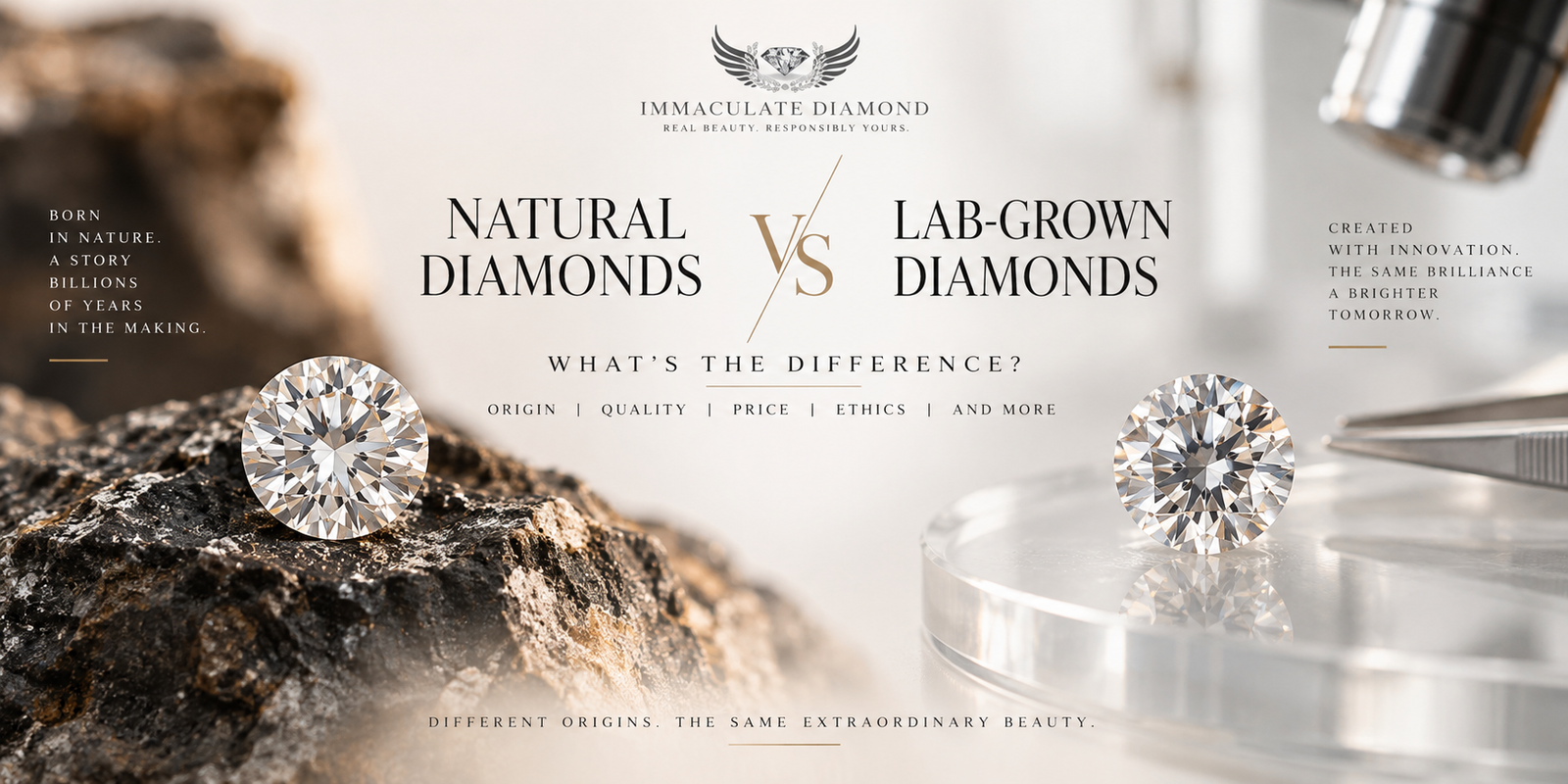
Natural Diamonds vs. Lab-Grown Diamonds: What's the Difference and Which Should You Choose?
Choosing a diamond is about more than finding something beautiful. For many people, it is also about understanding where the diamond came from, how it was made, what they are paying for, and whether they are making the right choice for themselves.
Today, diamond buyers have two main options: natural diamonds and laboratory-grown diamonds.
Both can be exceptional gemstones. Both can be cut into the same shapes, graded by the same fundamental 4Cs, and set into beautiful fine jewelry. To the naked eye, a well-cut natural diamond and a well-cut laboratory-grown diamond can look remarkably alike.
The biggest difference is not what happens when light enters the stone. It is where and how the diamond formed.
Natural diamonds formed deep within the Earth over geological timescales. Laboratory-grown diamonds are created by advanced technology in controlled laboratory environments, using processes that reproduce the conditions necessary for diamond growth.
So, which one should you choose?
The answer depends on what matters most to you: geological rarity and natural origin, size and value, personal preference, budget, sourcing considerations, or simply the diamond that looks best to your eye.
Let's break down the differences.
What Is a Natural Diamond?
A natural diamond is a diamond that formed naturally within the Earth.
Deep beneath the Earth's surface, carbon atoms were exposed to extremely high temperatures and pressures over immense periods of geological time. Under the right conditions, those carbon atoms crystallized into diamond.
Natural diamonds can eventually be brought closer to the Earth's surface through geological processes and volcanic activity. They are then recovered, cut, polished, graded and eventually turned into jewelry.
Some natural diamonds are more than a billion years old.
That extraordinary geological history is one of the reasons natural diamonds hold such a unique place in the world of gemstones.
Every natural diamond has its own geological story. Its inclusions, growth patterns, trace elements and characteristics developed naturally during its formation.
For many buyers, that history is part of the appeal.
A natural diamond is not simply a gemstone. It is a small piece of Earth's geological history.
What Is a Lab-Grown Diamond?
A laboratory-grown diamond is a diamond created in a controlled laboratory environment.
Instead of waiting for geological processes to create a diamond deep inside the Earth, scientists recreate the conditions needed for diamond growth using advanced technology.
The two primary methods used today are:
HPHT: High Pressure High Temperature
HPHT technology recreates the high-pressure and high-temperature environment associated with natural diamond formation.
A small diamond seed is placed into a controlled environment containing a carbon source. Under carefully controlled pressure and temperature, carbon crystallizes around the seed and gradually develops into a diamond.
CVD: Chemical Vapor Deposition
CVD uses a different approach.
A thin diamond seed is placed inside a chamber containing a carbon-rich gas. The gas is activated under controlled conditions, causing carbon atoms to deposit onto the diamond seed and grow the crystal layer by layer.
Both HPHT and CVD can produce genuine diamonds.
The growth method may be documented on a laboratory-grown diamond grading report.
Are Lab-Grown Diamonds Real Diamonds?
Yes.
This is one of the most common questions people ask.
A laboratory-grown diamond is not the same thing as a diamond simulant such as cubic zirconia or glass.
A lab-grown diamond has essentially the same chemical, physical and optical properties as a natural diamond. The fundamental difference is its origin.
GIA explains that laboratory-grown diamonds possess essentially the same chemical, physical and optical properties as natural diamonds.
This distinction is important.
Diamond simulant
A simulant looks like a diamond but is made from a different material.
Examples include:
- Cubic zirconia
- Moissanite
- Glass
Laboratory-grown diamond
A lab-grown diamond is diamond.
It is created through a technological process rather than formed naturally inside the Earth.
That is why it should not be confused with imitation or simulated diamonds.
The FTC also distinguishes laboratory-created diamonds from diamond simulants and states that laboratory-created diamonds must have essentially the same optical, physical and chemical properties as mined diamonds.
Natural vs. Lab-Grown Diamonds at a Glance
| Feature | Natural Diamond | Lab-Grown Diamond |
|---|---|---|
| Origin | Formed naturally inside the Earth | Created in a controlled laboratory |
| Formation time | Geological timescales, often billions of years | Typically weeks rather than geological timescales |
| Material | Diamond | Diamond |
| Chemical properties | Essentially crystalline carbon | Essentially crystalline carbon |
| Optical properties | Diamond | Diamond |
| Hardness | 10 on Mohs scale | 10 on Mohs scale |
| Brilliance | Depends largely on cut | Depends largely on cut |
| 4Cs | Graded for cut, color, clarity and carat | Graded for cut, color, clarity and carat |
| Certification | Available from major gemological laboratories | Available from major gemological laboratories |
| Origin identification | Natural | Laboratory-grown |
| Typical price | Higher | Generally lower |
| Geological history | Yes | No |
| Main appeal | Natural rarity and history | Diamond properties, value and controlled origin |
Both natural and laboratory-grown diamonds can be evaluated using the familiar diamond grading characteristics known as the 4Cs: cut, color, clarity and carat weight.
Can You Tell a Natural Diamond and Lab-Grown Diamond Apart by Looking at Them?
Usually, no.
This is another common misconception.
A trained person may be able to notice certain characteristics under magnification that suggest a particular growth process, but determining whether a diamond is natural or laboratory-grown reliably requires specialized gemological testing.
GIA notes that because laboratory-grown diamonds are chemically and optically similar to natural diamonds, traditional visual observations and basic diamond testers are not sufficient to reliably distinguish them. Advanced laboratory equipment is used to identify their origin.
In other words, two diamonds can look virtually identical when worn in a ring or pair of earrings while having completely different origins.
That is why a reputable grading report matters.
Does a Lab-Grown Diamond Have the Same Sparkle as a Natural Diamond?
A well-cut lab-grown diamond can have the same fundamental optical properties as a natural diamond.
The amount of sparkle you see is influenced heavily by cut quality.
A diamond's proportions, facet arrangement, symmetry and polish determine how efficiently it interacts with light.
This is why two diamonds of the same carat weight can look completely different.
One may appear bright, lively and full of fire, while another may look dull because of poor cutting.
The same principle applies whether the diamond is natural or laboratory-grown.
Origin does not replace cut quality.
If maximum brilliance is your priority, pay close attention to the cut rather than choosing a diamond solely because of its carat weight or color grade.
The 4Cs Apply to Both
When comparing natural and laboratory-grown diamonds, it is easy to become focused on their origin and forget the basics.
The 4Cs remain extremely important:
1. Cut
Cut determines how effectively a diamond interacts with light.
A beautifully cut diamond can appear exceptionally bright and lively.
For many buyers, cut should be one of the first things to consider.
2. Color
Diamond color is generally graded from D through Z for standard colorless-to-light-yellow diamonds.
D represents the highest colorless grade, while progressively lower grades show increasing warmth.
The right color depends on the diamond, setting, metal and your personal preference.
3. Clarity
Clarity describes the presence of internal characteristics, called inclusions, and surface characteristics, called blemishes.
Higher clarity grades generally contain fewer visible characteristics.
But higher clarity does not automatically mean a diamond will look better to the naked eye.
A diamond with slightly lower clarity can still appear completely clean when viewed without magnification.
4. Carat Weight
Carat refers to weight, not simply visual size.
Two diamonds with the same carat weight can have different measurements and proportions, meaning one may appear larger face-up than another.
This is why choosing a diamond should never be based on carat weight alone.
Why Are Lab-Grown Diamonds Less Expensive?
This is one of the biggest practical differences between the two options.
Laboratory-grown diamonds can generally be purchased for significantly less than comparable natural diamonds.
The reason is largely related to supply and origin.
A natural diamond requires geological formation over an immense period of time and then must be discovered and recovered through mining and the rest of the supply chain.
A laboratory-grown diamond can instead be produced in a controlled environment.
As production technology has developed and manufacturing has expanded, laboratory-grown diamonds have become increasingly accessible.
That means a buyer who has a fixed budget may be able to choose:
A smaller natural diamond
or
A larger laboratory-grown diamond with similar quality characteristics.
For example, someone with a $5,000 jewelry budget may prefer the history and natural origin of a smaller natural diamond.
Another buyer may prefer to use the same budget for a larger laboratory-grown center stone.
Neither choice is inherently wrong.
They simply prioritize different things.
Does a Natural Diamond Hold More Value?
This requires an important distinction.
Price and value are not the same thing.
Natural diamonds have traditionally commanded higher prices because of their natural origin, rarity, established market and cultural significance.
Laboratory-grown diamonds generally cost substantially less at retail.
But neither type of diamond should automatically be treated as an investment.
A diamond purchased as jewelry should primarily be chosen for its beauty, meaning and personal significance.
If resale value is important to you, it is worth discussing the specific stone and current market conditions with a qualified jeweler or appraiser rather than assuming that either type will appreciate.
A grading report documents a diamond's characteristics, but a grading report itself is not an appraisal or guarantee of resale price.
Are Natural Diamonds Rarer?
Yes.
Natural diamonds are the product of geological processes that occur naturally and over enormous periods of time.
That makes their supply inherently limited by nature.
Laboratory-grown diamonds are different because humans can produce them using controlled manufacturing processes.
This distinction is important when considering the word rare.
A laboratory-grown diamond can be beautiful, durable and chemically a diamond while still not having the geological rarity of a natural diamond.
For some people, that rarity is an essential part of the meaning behind owning a diamond.
For others, it is less important than the appearance, size, quality and price.
Both perspectives are valid.
Natural Diamonds Have a Geological Story
One of the strongest reasons people choose natural diamonds is the story behind them.
Imagine wearing a gemstone that formed deep within the Earth long before modern civilization existed.
Its carbon atoms experienced extraordinary pressure and temperature conditions and remained part of geological processes for an immense period of time before eventually becoming a polished gemstone.
That history cannot be replicated.
A natural diamond is therefore appealing to people who value:
- Geological rarity
- Natural formation
- History
- Tradition
- Long-established diamond culture
- The individuality of naturally occurring characteristics
For these buyers, the origin is part of the emotional value.
Lab-Grown Diamonds Have a Different Story
The appeal of a laboratory-grown diamond comes from a different idea.
Instead of geological history, the story is one of technology, precision and controlled creation.
A diamond can be grown in a laboratory environment and then cut and polished into a finished gemstone with the same fundamental diamond properties as a natural stone.
For many modern buyers, this offers an attractive combination of:
- Diamond quality
- Modern technology
- Greater size for the budget
- Controlled production
- Transparency about laboratory origin
A laboratory-grown diamond does not need to pretend to be natural to be meaningful.
Its story is simply different.
Are Lab-Grown Diamonds More Ethical?
This question deserves a careful answer.
You will often see laboratory-grown diamonds described as ethical, sustainable or eco-friendly.
However, those claims should not be treated as universal facts without context.
Laboratory-grown diamonds avoid the need to extract the diamond crystal through conventional mining, which is an important difference.
But laboratory production still requires energy, equipment, raw materials and industrial processes.
The environmental footprint can therefore vary depending on how and where a laboratory-grown diamond is produced and what energy sources are used.
Natural diamonds also have an environmental and social footprint associated with mining, processing and transportation, but responsible mining can provide employment, infrastructure and economic benefits in producing regions.
For this reason, it is better to ask how a particular diamond was produced and sourced rather than assuming that one category is automatically ethical in every circumstance.
At Immaculate Diamond, transparency should always come before exaggerated environmental claims.
What About Conflict Diamonds?
The term conflict diamond generally refers to diamonds associated with armed conflict and human-rights abuses.
The modern diamond industry has established systems designed to prevent conflict diamonds from entering legitimate international trade.
However, responsible sourcing is broader than simply asking whether a diamond is conflict-free.
Consumers increasingly want to know about:
- Where a diamond came from
- How it was produced
- Whether suppliers are traceable
- Labor conditions
- Environmental practices
- Responsible business practices
Whether you choose a natural or laboratory-grown diamond, asking questions about sourcing is a positive part of becoming an informed jewelry buyer.
Which One Is More Durable?
Both natural and laboratory-grown diamonds are extremely durable.
Diamond ranks at 10 on the Mohs hardness scale, making it the hardest naturally occurring mineral and exceptionally resistant to scratching. IGI notes that both natural and laboratory-grown diamonds reach 10 on the Mohs scale.
However, hardness should not be confused with being impossible to damage.
A diamond can still chip or fracture under a sufficiently strong impact, particularly around certain vulnerable areas such as sharp corners or points.
That is why good jewelry design and proper care matter regardless of the diamond's origin.
A well-made setting can help protect the stone during everyday wear.
Can Lab-Grown Diamonds Be Certified?
Yes.
Laboratory-grown diamonds can be examined and documented by independent gemological laboratories.
A grading report can identify the stone as laboratory-grown and provide information about characteristics such as:
- Carat weight
- Color
- Clarity
- Cut
- Measurements
- Proportions
- Polish
- Symmetry
- Growth method, depending on the laboratory and report
- Treatments, where applicable
IGI, for example, provides laboratory-grown diamond reports that identify the diamond's laboratory-grown origin and document its 4Cs and other gemological characteristics.
GIA also provides laboratory-grown diamond services and uses distinct reporting formats to differentiate laboratory-grown diamonds from natural diamonds.
A report gives the buyer independent documentation rather than asking them to simply trust a seller's description.
Why Certification Matters
Imagine you are comparing two diamonds that appear almost identical.
One has an independent grading report.
The other does not.
The certified diamond gives you documented information about its characteristics and origin.
That makes comparison easier and gives you an additional layer of confidence when making a purchase.
A grading report does not tell you whether you will personally love the diamond.
It does, however, give you objective information that helps you understand what you are buying.
For a significant jewelry purchase, that transparency matters.
Can a Jeweler Tell Whether a Diamond Is Lab-Grown?
A trained gemologist may recognize characteristics that suggest laboratory growth, but definitive identification generally requires appropriate testing equipment.
Modern gemological laboratories use advanced instruments to examine features that can reveal the diamond's growth history.
These can include:
- Growth patterns
- Spectroscopic characteristics
- Fluorescence and phosphorescence behavior
- Inclusions
- Trace elements
- Other diagnostic characteristics
GIA explains that specialized laboratory equipment is required to reliably separate laboratory-grown diamonds from natural diamonds.
This is one reason diamond identification technology has become increasingly important as laboratory-grown diamonds have become more common.
Natural vs. Lab-Grown: Which Looks Better?
There is no universal winner.
A beautiful diamond is a beautiful diamond.
If two stones have excellent cutting, attractive proportions and comparable color and clarity, both can produce exceptional brilliance.
The difference you can see with your eyes may be far less significant than the difference in:
- Cut quality
- Shape
- Proportions
- Color
- Clarity
- Setting
- Lighting conditions
This is why we recommend looking beyond the simple question of natural or lab-grown.
Instead, ask:
Does this particular diamond look beautiful to me?
Which Is Better for an Engagement Ring?
Both can be excellent choices for an engagement ring.
Choose a natural diamond if you value:
- Natural geological origin
- Rarity
- Tradition
- The history behind the gemstone
- The idea of owning a naturally formed diamond
- Long-established diamond culture
Choose a lab-grown diamond if you value:
- A larger stone within a particular budget
- Modern technology
- Diamond quality at a lower purchase price
- Controlled laboratory origin
- The ability to prioritize size or higher specifications within your budget
Neither choice makes an engagement ring more meaningful.
The meaning comes from the person, the relationship and the moment the ring represents.
What About Diamond Resale?
This is an area where buyers should have realistic expectations.
Neither natural nor laboratory-grown diamonds should automatically be purchased with the expectation that they will increase in value.
Retail pricing includes more than the intrinsic value of the diamond. It can include craftsmanship, design, branding, retail expenses, certification, labor and other costs.
The price you pay for a finished engagement ring is therefore not necessarily the price you could receive if you later sold it.
Natural diamonds have a more established secondary market, while laboratory-grown diamonds have generally experienced stronger price pressure as production has expanded.
If resale matters to you, consider the purchase primarily as fine jewelry rather than an investment and ask for a professional valuation when appropriate.
Is a Lab-Grown Diamond a Cheap Diamond?
Not necessarily.
The word cheaper can be misleading.
A laboratory-grown diamond may have a lower market price than a comparable natural diamond, but that does not mean it is a lower-quality material.
A lab-grown diamond can still have:
- Excellent cutting
- High clarity
- High color
- Exceptional brilliance
- A professional grading report
- Beautiful craftsmanship
The lower price primarily reflects its origin and the ability to produce diamonds through controlled technology rather than waiting for natural geological formation.
Think of it as two different paths to the same fundamental gemstone material.
What Should You Actually Spend Your Money On?
This is perhaps the most useful question for a diamond buyer.
Instead of spending your entire budget chasing the highest possible grades, consider where additional money will actually improve the appearance of the diamond.
For many buyers, a well-cut diamond with slightly lower clarity can look more beautiful than a poorly cut diamond with a higher clarity grade.
Similarly, the highest color grade may not always be necessary depending on the setting and metal color.
A thoughtful diamond selection balances:
Cut + Color + Clarity + Carat + Shape + Budget
rather than maximizing every specification independently.
So, Natural or Lab-Grown?
There is no single answer that is right for everyone.
Natural diamonds are ideal for buyers who value:
Rarity
A naturally formed gemstone created through geological processes.
History
A diamond with a geological story measured in immense spans of time.
Tradition
A gemstone with a long-established place in engagement rings and fine jewelry.
Natural origin
The knowledge that the diamond was formed naturally rather than manufactured.
Lab-grown diamonds are ideal for buyers who value:
Value
More diamond for a given budget.
Modern technology
A diamond created through advanced controlled processes.
Choice
Greater flexibility to prioritize size, color, clarity or shape.
Laboratory origin
A transparent alternative to mined diamonds with a clearly defined method of creation.
The Most Important Thing: Choose the Diamond, Not Just the Category
Natural versus lab-grown is an important decision, but it shouldn't be the only decision.
Two laboratory-grown diamonds can look completely different.
Two natural diamonds can look completely different.
The diamond's cut, proportions, clarity, color, shape and overall craftsmanship all influence how it looks when you actually wear it.
That's why the best approach is to first decide what matters most to you.
Do you want the natural history and rarity of a mined diamond?
Or would you rather use your budget to achieve a larger or higher-specification laboratory-grown diamond?
Neither choice is wrong.
They simply tell different stories.
Natural Diamond vs. Lab-Grown Diamond: Final Comparison
| If You Care Most About... | Natural Diamond | Lab-Grown Diamond |
|---|---|---|
| Natural origin | YES | |
| Geological history | YES | |
| Natural rarity | YES | |
| Traditional appeal | YES | |
| Lower purchase price | YES | |
| Larger size for budget | YES | |
| Controlled laboratory origin | YES | |
| Diamond material | YES | YES |
| Diamond hardness | YES | YES |
| Diamond brilliance | YES | YES |
| 4Cs grading | YES | YES |
| Professional certification | YES | YES |
Final Thoughts
The natural-versus-lab-grown conversation is sometimes presented as if one option has to be the winner.
It doesn't.
Natural diamonds and laboratory-grown diamonds represent two different ways of owning one of the world's most enduring gemstones.
A natural diamond offers something that cannot be recreated: natural geological history and rarity.
A laboratory-grown diamond offers something different: the ability to create a genuine diamond through modern technology and make exceptional diamond quality more accessible at a lower price.
Both can be beautiful. Both can be durable. Both can be graded. And both can become part of a meaningful piece of jewelry.
The right choice is ultimately the one that fits your priorities, your budget and the story you want your jewelry to tell.
At Immaculate Diamond, we believe choosing a diamond should never be about pressure or confusion. It should be about having the information to make a decision you feel confident about.
Because the perfect diamond isn't simply the one with the highest grade or the biggest carat weight. It's the one that feels right when you look at it, wear it and remember why you chose it.