
Diamond Shapes Explained: How to Choose the Right Diamond Shape
Diamond Shapes Explained: How to Choose the Right Diamond ShapeChoosing a diamond is about more than carat weight, color and clarity. One of the first decisions you'll make is which diamond shape you love.
The shape of a diamond has a major influence on the overall appearance of a piece of jewelry. It affects how the diamond looks from above, how large it appears, how it interacts with light and even the personality of an engagement ring.
From the timeless brilliance of a Round diamond to the elegant proportions of an Emerald cut or the romantic silhouette of a Pear shape, every diamond shape has something different to offer.
There is no single best diamond shape.
The right one is the shape that matches your personal style, your jewelry design and the way you want your diamond to look when you wear it.
Let's explore the most popular diamond shapes and what makes each one special.
What Is a Diamond Shape?
The shape of a diamond has a major influence on the overall appearance of a piece of jewelry. It affects how the diamond looks from above, how large it appears, how it interacts with light and even the personality of an engagement ring.
From the timeless brilliance of a Round diamond to the elegant proportions of an Emerald cut or the romantic silhouette of a Pear shape, every diamond shape has something different to offer.
There is no single best diamond shape.
The right one is the shape that matches your personal style, your jewelry design and the way you want your diamond to look when you wear it.
Let's explore the most popular diamond shapes and what makes each one special.
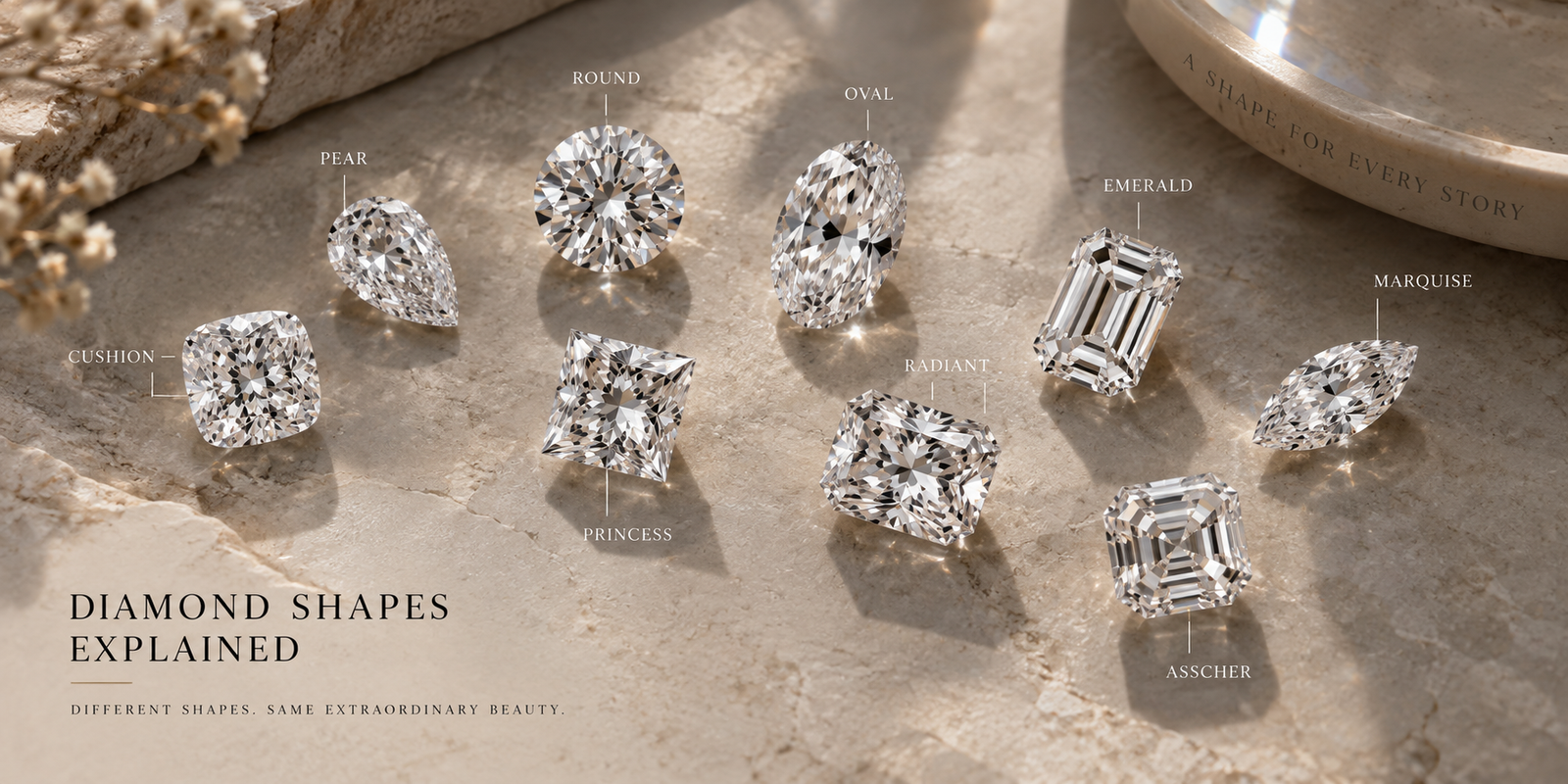
Diamond shape refers to the overall outline or silhouette of a diamond when viewed from above.
Some of the most popular shapes include:
- Round
- Oval
- Emerald
- Cushion
- Pear
- Marquise
- Princess
- Radiant
- Asscher
Each shape has its own proportions, facet arrangement and visual character.
Shape is one of the first things people notice about a diamond, which is why it can have such a strong influence on the personality of a ring or other piece of jewelry.
Diamond Shape vs. Diamond Cut: What's the Difference?
These two terms are often confused.
Shape refers to the diamond's outline.
Cut refers to how the diamond has been proportioned, faceted, polished and finished to interact with light.
For example, you might choose an Oval-shaped diamond.
That tells you the outline of the stone.
The quality of its cutting tells you how effectively that diamond handles light.
This distinction is important because two diamonds can have the same shape but look very different depending on their proportions, symmetry, polish and overall cut quality.
1. Round Brilliant Diamond
The Round Brilliant is the most classic and recognizable diamond shape.
Its circular outline and carefully arranged facets are designed to create exceptional light performance.
Round diamonds are known for their:
- Classic appearance
- Strong brilliance
- Timeless appeal
- Versatility
- Ability to work with almost any setting style
A Round diamond can look equally beautiful in a simple solitaire, a halo setting, a three-stone ring or a more elaborate design.
Who should choose a Round diamond?
A Round diamond is an excellent choice if you love:
Classic elegance
You want a style that will never feel dated.
Maximum brilliance
You love a diamond that catches the light from every angle.
Versatility
You want a stone that works with almost any jewelry design.
Traditional engagement rings
You want the classic diamond engagement ring look.
For someone buying their first diamond and feeling unsure about which shape to choose, Round is often the natural starting point.
2. Oval Diamond
Oval diamonds combine the brilliance of a traditional brilliant-style diamond with a more elongated silhouette.
Their stretched shape can create an elegant and graceful appearance.
One of the biggest attractions of an Oval diamond is its face-up presence.
Because of its elongated outline, an Oval can sometimes appear larger than a Round diamond of similar carat weight when viewed from above.
Oval diamonds are particularly popular in modern engagement ring designs.
Why choose an Oval?
Oval diamonds offer:
- Elegant proportions
- A modern interpretation of a classic diamond
- Strong brilliance
- A flattering elongated appearance
- A larger-looking face-up presence
They can also create the appearance of longer, more slender fingers depending on the ring design and how the stone is positioned.
The bow-tie effect
One characteristic buyers should be aware of with elongated shapes is the bow-tie effect.
A bow-tie appears as a darker area across the center of some Oval diamonds and can also occur in other elongated shapes.
A subtle bow-tie can be attractive and add contrast, while a very strong one can make the center of the diamond appear darker.
This is why looking at the individual diamond is important rather than choosing an Oval based only on its grading information.
3. Emerald Cut Diamond
The Emerald cut is instantly recognizable because of its long, clean lines and large step facets.
Unlike brilliant-style diamonds that emphasize intense sparkle through numerous smaller facets, Emerald cuts create a more understated form of beauty.
They are known for:
- Clean lines
- Elegant geometry
- Large flashes of light
- A sophisticated appearance
- A distinctive hall-of-mirrors effect
The broad, open facets also mean that clarity can be more noticeable in an Emerald cut.
For this reason, clarity deserves particular attention when choosing an Emerald diamond.
Who should choose an Emerald cut?
Choose Emerald if your style is:
Elegant
You prefer sophistication over maximum sparkle.
Minimalist
You appreciate clean lines and simple geometry.
Architectural
You love structured, modern designs.
Timeless
You want something classic without choosing a traditional Round diamond.
Emerald cut diamonds are especially beautiful in solitaire and three-stone settings.
4. Cushion Cut Diamond
Cushion diamonds have a soft, romantic appearance created by their rounded corners and square or rectangular outline.
The name comes from their cushion-like shape.
Cushion diamonds can have different facet patterns, which means their appearance can vary considerably from one stone to another.
They can offer a combination of:
- Soft edges
- Romantic character
- Beautiful brilliance
- Vintage-inspired appeal
- Modern versatility
Who should choose a Cushion diamond?
Cushion is ideal if you want something that feels:
- Romantic
- Soft
- Elegant
- Slightly vintage
- Less conventional than Round
A Cushion diamond can work beautifully in both vintage-inspired and contemporary engagement rings.
5. Pear-Shaped Diamond
The Pear shape combines a rounded end with a pointed tip.
It creates a distinctive teardrop silhouette that feels elegant and romantic.
Pear diamonds are particularly interesting because they can be worn in different orientations.
The point can face toward or away from the hand depending on the design and personal preference.
Why choose a Pear diamond?
Pear diamonds offer:
- A unique silhouette
- Elegant proportions
- A romantic appearance
- Strong visual presence
- A distinctive alternative to Round
They can look especially beautiful as the center stone of an engagement ring or as part of earrings and pendants.
Protecting the pointed tip
Because the tip is relatively delicate compared with the rounded portion of the stone, the setting should provide appropriate protection.
A well-designed setting can help reduce the risk of damage to the pointed end during everyday wear.
6. Marquise Diamond
The Marquise shape has a long, narrow silhouette with pointed ends.
Its distinctive outline gives it plenty of personality and can create an impressive visual presence.
Like Oval and Pear diamonds, its elongated proportions can make the diamond appear larger from the top than some other shapes of the same carat weight.
Why choose Marquise?
Marquise diamonds are ideal for someone who wants:
- A distinctive shape
- A vintage-inspired look
- A long, elegant silhouette
- Strong visual presence
- Something less traditional than Round
The pointed ends should be properly protected by the setting, especially for a ring intended for frequent everyday wear.
7. Princess Cut Diamond
The Princess cut is a square or rectangular shape with sharp corners and a modern geometric appearance.
It became particularly popular in contemporary engagement ring designs.
Princess diamonds can offer:
- Strong brilliance
- Clean geometry
- A modern appearance
- Sharp, defined edges
- Excellent versatility
Its square shape makes it especially suitable for modern and structured jewelry designs.
Who should choose a Princess cut?
It's a great choice if you prefer:
Modern design
You like clean, geometric jewelry.
Sharp lines
You want something more structured than an Oval or Cushion.
Contemporary elegance
You want a classic diamond but with a more modern silhouette.
Because of its sharp corners, protective setting design is particularly important.
8. Radiant Cut Diamond
Radiant diamonds combine the clean outline of a square or rectangular shape with brilliant-style faceting.
The result is a diamond with:
- Strong sparkle
- Modern geometry
- Softened corners
- A bold appearance
- Excellent versatility
Radiant diamonds can be square or elongated rectangular.
This makes them particularly flexible for different ring designs.
Why choose Radiant?
Radiant is a great middle ground if you love the shape of an Emerald cut but want more brilliance.
It offers the clean structure of a rectangular or square diamond while using faceting designed for lively light performance.
9. Asscher Cut Diamond
The Asscher cut is known for its square shape, cropped corners and distinctive step-faceted pattern.
It has a strong Art Deco influence and creates a very recognizable appearance.
Instead of producing the intense sparkle associated with brilliant cuts, Asscher diamonds create broad reflections and geometric flashes of light.
Who should choose Asscher?
Asscher is ideal for someone who loves:
- Art Deco design
- Vintage-inspired jewelry
- Geometric patterns
- Clean symmetry
- Understated sophistication
An Asscher diamond can be especially striking in a simple setting where the stone itself remains the focus.
Which Diamond Shape Looks the Largest?
Carat weight doesn't tell the whole story when it comes to visual size.
Different shapes distribute their weight differently, which means some shapes can have a larger face-up appearance than others.
Elongated shapes such as:
- Oval
- Pear
- Marquise
- Radiant
can sometimes appear larger from the top compared with other diamonds of similar weight.
However, actual visual size depends on the individual diamond's measurements and proportions.
That's why it's better to compare millimeter dimensions rather than relying only on carat weight.
Round vs. Oval: Which Should You Choose?
This is one of the most common comparisons.
Choose Round if you want:
- Maximum classic appeal
- A timeless silhouette
- Strong brilliance
- A traditional engagement ring
Choose Oval if you want:
- An elongated shape
- A more contemporary look
- Strong brilliance
- A larger-looking face-up appearance
- Something familiar but less traditional
Both can be beautiful.
The decision usually comes down to whether you prefer classic symmetry or elongated elegance.
Emerald vs. Radiant: What's the Difference?
These two rectangular shapes can look similar at first glance, but their personalities are very different.
Emerald
Elegant, clean and understated.
Its step facets create broad flashes and a distinctive hall-of-mirrors effect.
Radiant
Brilliant, lively and energetic.
Its faceting creates more sparkle while maintaining a rectangular or square outline.
So if you love the shape of an Emerald but want more sparkle, a Radiant may be worth considering.
If you prefer quiet sophistication and geometric reflections, Emerald may be the better choice.
Which Diamond Shape Has the Most Sparkle?
Brilliance depends heavily on the individual diamond's cut quality and proportions, so there isn't a simple answer that one shape will always sparkle more than every other shape.
Round Brilliant diamonds are particularly well known for their brilliance because their facet arrangement is specifically designed for strong light performance.
Other brilliant-style shapes, including Oval, Cushion, Pear, Marquise, Princess and Radiant, can also produce beautiful sparkle when well cut.
Step-cut shapes such as Emerald and Asscher create a different visual effect.
Rather than looking for the shape with the most sparkle in theory, compare actual diamonds and choose the light performance you personally enjoy.
Which Diamond Shape Is Most Timeless?
If timelessness is your priority, Round is difficult to beat.
Its circular silhouette has remained a classic choice for generations.
However, timeless does not have to mean traditional.
Oval, Emerald and Cushion diamonds have also maintained strong popularity because their silhouettes work beautifully across different jewelry styles.
The best timeless choice is ultimately the one whose shape you can imagine loving years from now.
Which Diamond Shape Is Most Unique?
If you want something less conventional, consider:
Pear
Romantic and distinctive.
Marquise
Dramatic and vintage-inspired.
Asscher
Geometric and unmistakable.
Radiant
Modern with plenty of brilliance.
Emerald
Sophisticated and understated.
Uniqueness isn't necessarily about choosing the rarest shape.
Sometimes it's simply about choosing the shape that feels most like you.
Does Diamond Shape Affect Price?
Yes, shape can influence pricing.
Round diamonds have historically carried a premium compared with many fancy shapes, although pricing varies depending on market conditions and the individual diamond.
Other factors also have a major impact, including:
- Carat weight
- Color
- Clarity
- Cut quality
- Proportions
- Certification
- Demand
- Overall appearance
This means you shouldn't assume that one shape is always cheaper or more expensive.
Compare individual diamonds rather than relying only on general price expectations.
How Your Ring Setting Changes the Look of a Diamond
The diamond shape is only part of the finished design.
The setting can completely change how the same diamond feels.
For example:
Solitaire
Places almost all attention on the center stone.
Excellent for Round, Oval, Emerald and many other shapes.
Halo
Surrounds the center diamond with smaller stones, creating additional sparkle and visual presence.
Three-Stone
Places diamonds alongside the center stone, creating a balanced and symbolic design.
Hidden Halo
Adds additional diamonds underneath the center stone while keeping the overall look more subtle from above.
Bezel
Surrounds the diamond with metal and offers a clean, modern appearance.
The right setting should complement the diamond rather than compete with it.
Diamond Shape and Your Personal Style
One of the easiest ways to choose a shape is to think about the jewelry you already love.
If your style is classic:
Consider Round.
If your style is elegant and modern:
Consider Oval or Emerald.
If your style is romantic:
Consider Cushion or Pear.
If your style is bold:
Consider Marquise or Radiant.
If your style is geometric:
Consider Princess or Asscher.
Of course, these aren't rules.
They're simply a starting point.
Your favorite diamond shape may be the one you least expected to choose.
Does Finger Shape Matter When Choosing a Diamond?
There are countless guides online that claim certain diamond shapes are exclusively suited to certain fingers.
The reality is much simpler.
You should choose the shape you love.
That said, elongated shapes such as Oval, Pear and Marquise can create a visually lengthening effect because of their vertical proportions.
Round and Cushion shapes can create a more balanced, symmetrical appearance.
But the ring's width, setting, orientation and overall design can be just as influential as the diamond itself.
Your comfort and personal preference should always come first.
Natural or Lab-Grown: Does Diamond Shape Change?
No.
You can find many of the same popular diamond shapes in both natural and laboratory-grown diamonds.
You can choose:
- Natural Round
- Lab-grown Round
- Natural Oval
- Lab-grown Oval
- Natural Emerald
- Lab-grown Emerald
- And many other combinations
The choice between natural and laboratory-grown diamonds is primarily about origin, while shape is about design and appearance.
If you're still deciding between the two origins, read our guide:
Natural vs. Lab-Grown Diamonds: What's the Difference?
It explains the differences in origin, price, rarity, certification and other important considerations.
A Quick Diamond Shape Comparison
| Shape | Overall Style | Sparkle | Visual Presence | Best For |
|---|---|---|---|---|
| Round | Classic | Excellent | Balanced | Timeless elegance |
| Oval | Elegant | Excellent | Elongated | Modern sophistication |
| Emerald | Sophisticated | Refined | Strong | Clean, minimal style |
| Cushion | Romantic | Excellent | Soft | Vintage-inspired designs |
| Pear | Romantic | Excellent | Elongated | Unique elegance |
| Marquise | Dramatic | Excellent | Elongated | Bold, vintage style |
| Princess | Modern | Excellent | Square | Contemporary designs |
| Radiant | Modern | Excellent | Strong | Bold sparkle |
| Asscher | Art Deco | Refined | Square | Geometric elegance |
Actual appearance and light performance vary from diamond to diamond.
How to Choose the Right Diamond Shape
If you're still unsure, don't overthink it.
Start with these questions:
1. Do you prefer classic or distinctive?
If classic, start with Round.
If distinctive, explore Pear, Marquise, Asscher or Radiant.
2. Do you want maximum brilliance or a more understated look?
For strong brilliance, explore brilliant-style shapes such as Round, Oval, Cushion and Radiant.
For broader, more geometric reflections, consider Emerald or Asscher.
3. Do you want the diamond to look elongated?
Consider Oval, Pear or Marquise.
4. Do you prefer square or rectangular designs?
Look at Princess, Asscher, Emerald or Radiant.
5. What type of jewelry are you creating?
A diamond that looks beautiful on its own may look completely different once placed in a particular setting.
Always consider the finished design.
The Best Way to Choose Your Diamond Shape
Photos are helpful, but nothing replaces seeing different shapes side by side.
Look at several diamonds.
Compare their silhouettes.
Pay attention to how they interact with light.
Notice which one catches your attention first.
Then imagine that diamond in the jewelry you actually want to wear.
You may discover that the shape you originally planned to buy isn't the one you love most.
And that's completely fine.
Diamond shopping isn't about following a rule.
It's about finding something that feels right.
Final Thoughts
Every diamond shape tells a slightly different story.
Round feels timeless.
Oval feels elegant and modern.
Emerald feels sophisticated.
Cushion feels romantic.
Pear feels graceful and distinctive.
Marquise feels bold and dramatic.
Princess feels contemporary.
Radiant feels brilliant and confident.
Asscher feels architectural and refined.
There is no single shape that is better than the rest.
The right diamond shape depends on your personal style, the design you're creating, the proportions you love and the way you want your jewelry to feel when you wear it.
And remember, shape is only the beginning.
Once you've found a shape you love, consider its cut, color, clarity and carat weight to find the right balance of beauty and value.
If you're choosing between natural and laboratory-grown diamonds, origin is another important part of the decision.
At Immaculate Diamond, we believe the best jewelry starts with understanding what you're choosing.
Take your time. Compare different shapes. Look beyond the numbers.
And most importantly, choose the diamond that makes you stop and look twice.
Because the right shape isn't the one everyone else chooses. It's the one that feels unmistakably yours.